
Iran’s Anti-Infiltration Bill Restricts Lawful Freedoms in the Name of Independence
Iran’s proposed “anti-infiltration” law would place ordinary contact with foreign universities, media outlets, civil-society groups and professional organisations under security scrutiny—even though Iran’s own Constitution says lawful freedoms cannot be taken away in the name of protecting national independence.


Imagine applying for an overseas scholarship, giving an interview to an international news outlet or joining a research project with a foreign university—and first having to ask whether the contact must be registered with Iran’s security agencies. That is the practical concern raised by Iran’s proposed “Bill to Counter the Infiltration of Foreign Intelligence Services and Institutions,” commonly described as the anti-infiltration bill.
Related Articles

The 33-article committee text published by the Iranian parliament’s news agency brings a wide range of scientific, journalistic, legal, economic, cultural and civic relationships into a system of registration, vetting and approval. Penalties range from fines and professional bans to imprisonment and the dissolution of organisations.
The bill is not yet law. Iran’s parliament—the Islamic Consultative Assembly, or Majles—has approved its general principles and Articles 1 and 2, but it has not finished reviewing the full text. The remaining provisions may still change, and any final bill must also pass review by the Guardian Council, an unelected body that checks legislation against the Constitution and its interpretation of Islamic law.
That distinction matters. Article 1’s general prohibition and Article 2’s unusually broad definition of “activity” are no longer merely committee proposals: both have been approved on the parliament floor. The analysis of Articles 3 onward, however, is based on the committee’s 33-article version and should be read as an assessment of provisions still under review.
Where the bill stands
The first version, signed by 87 lawmakers, contained 19 articles and was formally introduced on July 16, 2025. Parliament’s National Security and Foreign Policy Committee then rewrote it, approving a 33-article version in January 2026.
Parliament approved the bill’s general principles on August 16, 2026. It approved Article 1 three days later by 176 votes to 16, followed by an amended Article 2 on August 25. Articles 3 and 4 were returned to committee for clarification. Debate on the rest continues.
Article 9: freedom cannot be abolished by passing a law
The bill’s central contradiction appears in the very first article approved by parliament.
Article 1 invokes Article 9 of the Constitution to justify restrictions intended to protect Iran’s independence. But Article 9 is not simply a national-security clause. It protects independence and territorial integrity while also placing a clear limit on the state:
“No authority has the right to abrogate legitimate freedoms, not even by enacting laws and regulations for that purpose, under the pretext of preserving the independence and territorial integrity of the country.”
The decisive words are “not even by enacting laws and regulations.” The constitutional text anticipates the very argument that a restriction becomes legitimate merely because parliament has enacted it. It says the opposite: legislation cannot be used as a formal route for taking away lawful freedom in the name of independence.
This does not prevent Iran from criminalising espionage, covert work for a foreign intelligence service or the unauthorised disclosure of classified information. Governments can legislate against a real and identifiable security threat. But the prohibited conduct must be defined precisely, and any restriction must be necessary and proportionate to that threat.
The anti-infiltration bill crosses that line because Article 2 does not confine “activity” to clandestine operations or contact with intelligence agencies. The article approved by parliament also covers publishing an article, applying for a scholarship, taking up a visiting fellowship, collaborating with a university, giving an interview or analysis, attending a conference, accepting an artistic residency, providing legal services and working with a non-governmental organisation.
The later provisions are meant to decide which of those relationships must be registered or receive security approval. In practice, a student, academic, journalist, lawyer or artist may have to seek permission before exercising a freedom that the legal system already recognises. The freedom remains on paper, but its exercise becomes conditional on the state’s approval. Preventing that result is precisely the purpose of the second half of Article 9.
Parliament added language to Article 1 referring to the deprivation of “freedoms recognised by law.” That amendment does not resolve the problem. If later provisions narrow the practical scope of freedom through vague offences and security-agency directives, the law can first shrink the right and then claim to protect only what remains. That is circular reasoning, not a constitutional safeguard.
How a scholarship application can become security data
Articles 3 to 10 of the committee text connect foreign contacts to an online “System for the Registration, Management and Monitoring of Foreign Relations.” The Interior Ministry would build the system. Iran’s Ministry of Intelligence and the Intelligence Organisation of the Islamic Revolutionary Guard Corps (IRGC) would have online access to it, could demand further information and explanations, and would act as law-enforcement officers for offences created by the bill.
For readers unfamiliar with Iran’s security structure, these are two separate intelligence bodies. The Ministry of Intelligence is the government’s civilian intelligence service. The IRGC Intelligence Organisation is the intelligence arm of the Islamic Revolutionary Guard Corps, a military-security institution with extensive domestic powers. Giving both bodies direct access matters because they would help define the rules, view the resulting data and investigate suspected violations.
The database would contain more than the names of foreign organisations. It would record the type and subject of an activity, the people involved and any changes to the relationship. Taken together, those records could map an individual’s or institution’s academic, professional, financial and civic networks.
The draft says nothing clear about how long the data may be retained, whether individuals can inspect or correct their records, when information must be deleted, whether officers’ access will be logged, how secondary uses will be restricted, when a person must be notified, or what independent body will oversee the system. Administrative registration data could therefore become the basis of a security profile, an opaque blacklist, a denial of services or a criminal case.
Even the boundary of “ordinary and everyday” contact is left undefined. The Ministry of Intelligence, the IRGC Intelligence Organisation and the Foreign Ministry would decide it later. At the time of enactment, people would still not know whether an initial scholarship email, an interview with a foreign outlet or attendance at a specialist meeting must be registered.
The government’s own lawmaking standards
Article 9 of the Constitution should not be confused with Paragraph 9 of Iran’s “General Legislative Policies.” Supreme Leader Ali Khamenei issued those policies in October 2019 as formal guidance for legislation. Paragraph 9 calls for laws that are clear, unambiguous, enforceable and measurable. It also calls for sound legal terminology, impact assessment, expert input, stakeholder participation, and the avoidance of unjustified discrimination and exemptions.
The 33-article bill fails those standards on its own terms. It uses phrases such as “weakening Iranian-Islamic culture,” “facilitating infiltration and domination,” “false analysis,” “undermining public trust,” “reducing election participation,” “directing voters,” presenting an “unfair image of society,” and “promoting anti-Islamic culture.” Any of these could trigger punishment, yet the text supplies no objective test for applying them.
What separates a “false analysis” from one that simply contradicts the state’s account? At what point does reporting on corruption or repression become “undermining public trust”? Who decides that a film presents an “unfair” picture of society?
When the law does not answer those questions, investigators and judges define the boundary after the conduct has occurred. The broader the offence, the greater the discretion of security agencies to choose a suspect and reinterpret lawful conduct as a threat. People are left guessing not only what is forbidden, but what might later be treated as forbidden.
Criminal rules left to future directives
Articles 3, 4, 6, 18 and 33 leave essential parts of the scheme to regulations that would be written later. Those rules would determine which contacts are routine, which activities require approval, who is exempt, which foreign entities are prohibited and how inspections will work.
Regulations can properly settle technical details. They should not determine the boundary between lawful and criminal conduct. Under Article 12, violating the registration and approval system can lead to punishment. An administrative decision by security agencies could therefore shape a person’s criminal liability.
This concern was also raised during the parliamentary debate. On August 25, lawmaker Alireza Salimi argued that Article 3 delegated legislative authority in a way that could violate Article 85 of the Constitution. The presiding officer accepted that the objection required review, and Articles 3 and 4 were returned to committee. Technical implementation may be delegated; the elements that create an offence and punishment must be understandable from the law itself.
A harsher penalty for some unclassified information
Article 20 would punish the unauthorised transfer to a “foreign agent” of any unpublished official information, report, data or statistics obtained through a person’s job or profession. The information need not be classified, and the provision does not require proof of actual harm. The penalty is grade-three imprisonment plus a lifetime ban from the related profession.
Article 25, by contrast, concerns the transfer of classified confidential or secret information and requires damage to national security or national interests. Yet it provides grade-four imprisonment and a fine. In Iran’s sentencing scale, grade three is more severe than grade four. The bill could therefore punish the transfer of unclassified information more harshly merely because it had not yet been published, even when the disclosure caused no proven damage.
This is more than a numbering error. Article 20 contains no clear public-interest, investigative-journalism or whistleblower defence. It also sits uneasily with the logic of Iran’s Publication and Free Access to Information Act, which distinguishes public information, private data and classified documents.
Article 32: punishing conduct far removed from an offence
Article 32 introduces grade-six imprisonment for what it calls “remote preparations,” even when the conduct is not independently criminal.
Article 123 of Iran’s Islamic Penal Code generally says that intent and preparatory acts not directly connected to the commission of an offence do not amount to a punishable attempt. Parliament may define a specific preparatory act as a separate offence, so Article 32 is not automatically invalid on that ground alone. The deeper problem is that it identifies no specific act.
“Remote preparations” has no objective limit, time frame or clear threshold of danger. Buying equipment, making a phone call, drafting an email or doing preliminary planning could be characterised by an investigator as preparation for an offence that never reached the attempt stage. Punishment would turn less on a clearly prohibited act than on a security agency’s interpretation of a person’s intent.
Dissolution and discrimination
Article 21 provides for the dissolution of trade associations, professional bodies, political parties and non-governmental organisations in accordance with Article 22 of the Islamic Penal Code. That does not mean every registration violation would automatically dissolve an organisation. Article 22 limits the penalty to cases in which a legal entity was created to commit an offence or was directed exclusively towards criminal activity.
Article 30 is more troubling. When an offence is committed using an organisation’s name or resources, in pursuit of its aims, at its direction or for its benefit, the article requires the court to dissolve the legal entity. It leaves no room to consider the seriousness of the violation, whether dissolution is necessary or whether a lesser penalty would be sufficient.
The registration scheme is also unequal. The armed forces, the Ministry of Intelligence and political officials are exempt from registering their foreign activities, while universities, institutes and civil-society organisations are not. Article 16 bars holders of foreign permanent residency from all government and public-sector employment without assessing the job, the person’s access to sensitive information or any individual risk. Article 23 increases the punishment of a foreign national by one grade solely because of nationality.
That structure conflicts with the fairness and non-discrimination requirements in Paragraph 9 of the General Legislative Policies. The state’s most powerful institutions are excused from registration, while citizens and independent organisations must disclose their relationships to those same institutions.
Self-censorship begins before any trial
The bill’s most important effect may not be the number of convictions. It may be the number of lawful relationships that never begin.
Lawyers call this a “chilling effect”: people avoid not only prohibited conduct but also lawful activity near an uncertain boundary because the consequences of guessing wrong are too severe. A student does not know whether an initial scholarship email must be registered. A professor cannot be sure how a research-data exchange will be treated. A journalist may worry that a foreign outlet will later be designated “hostile.” An artist receiving support from an overseas foundation may decide the risk is not worth taking.
Mass arrests are not required to produce that fear. An unclear offence, a permanent monitoring system and a severe penalty for mistakes may be enough.
The result could be a selective system of international access. Individuals and institutions close to the state may encounter fewer obstacles. Independent researchers, artists, journalists and civil-society organisations would have to accept the risks of registration, refusal and possible prosecution. Surveillance here would not merely investigate wrongdoing after the event; it would reshape lawful behaviour before it occurs.
Other constitutional rights at risk
Article 9 presents the clearest constitutional conflict, but it is not the only relevant guarantee.
Article 23 prohibits the investigation or punishment of people for their beliefs, while Article 24 recognises freedom of the press. Article 27 of the bill does not draw a clear line between criticism of religious doctrine, a negative account of the state and genuine incitement to violence or harm.
Article 25 of the Constitution protects correspondence and communications against intrusion. The proposed database would not necessarily collect the contents of every email, but it would create extensive metadata about people’s relationships and make that information available to security agencies without clear safeguards.
Constitutional Articles 26 and 27 recognise freedoms of association and assembly. Articles 21, 28 and 30 of the bill could nevertheless expose participation in programmes—and even the continued existence of an organisation—to criminal penalties.
Articles 34 to 37 protect access to justice, the right to counsel, the principle of legality and the presumption of innocence. The bill does not expressly remove the right to a lawyer, but it provides no clear route to challenge a security classification, a vetting decision, the denial of approval or incorrect data in the registration system. The printed wording of Article 31 also appears to allow punishment when knowledge or other elements of the offence have “not been established.” If applied literally, that drafting error would invert the presumption of innocence and the state’s duty to prove its case.
International obligations: rights placed at risk
Iran ratified both the International Covenant on Civil and Political Rights (ICCPR) and the International Covenant on Economic, Social and Cultural Rights (ICESCR) on June 24, 1975, without registering reservations. Because this bill is not yet in force, the legally accurate concern is that its text is incompatible with these obligations and creates a risk of future violations—not that every proposed provision has already produced a violation.
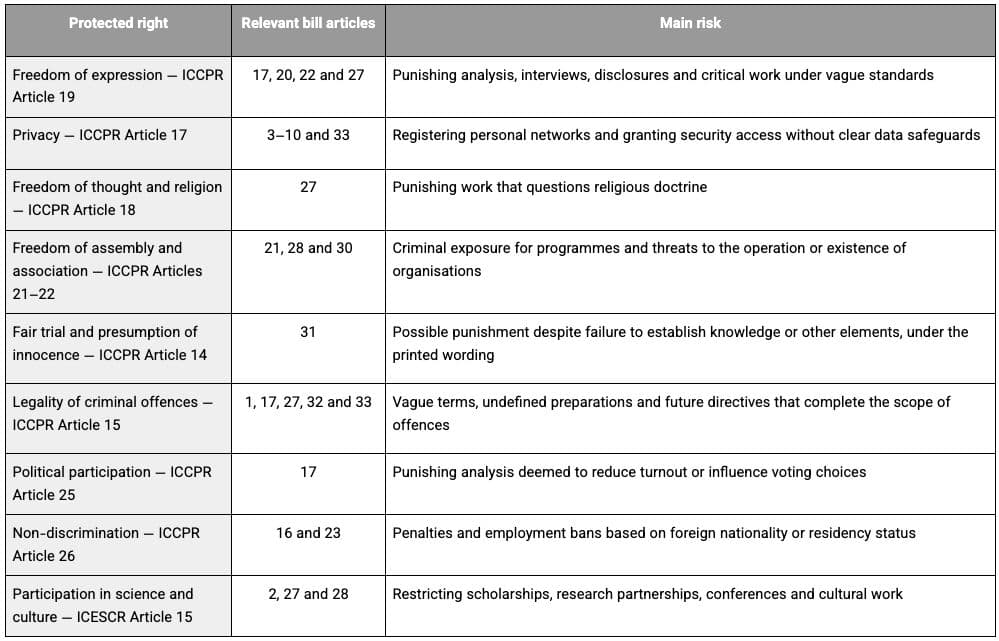
ICCPR Article 19 permits limited restrictions on expression for national security. But any restriction must be prescribed with precision, necessary to address a concrete threat and proportionate to that threat. “National security” is not a blank cheque to place every critical report or foreign media contact within reach of criminal law.
The same principle applies to privacy. Making data collection lawful is not enough; surveillance must not be arbitrary. Its purpose, duration and access rules must be defined, and affected people need an effective route to challenge misuse. A system that maps citizens’ academic and civic relationships while remaining silent on those safeguards is difficult to reconcile with ICCPR Article 17.
ICESCR Article 15 protects participation in cultural life, the benefits of scientific progress, the freedom necessary for research and the benefits of international contact in science and culture. Security registration or approval requirements for scholarships, visiting fellowships, conferences, artistic residencies and university collaborations would directly restrict the exercise of those rights.
Neither treaty prevents Iran from acting against covert foreign operations. The unresolved question is where the bill draws the line between a genuine security threat and lawful academic, journalistic, legal or cultural contact. As written, it does not draw that line clearly enough.
When national security becomes a pretext
Some of the bill’s aims are defensible. A ban on foreign financing of election campaigns may serve a legitimate purpose. The unauthorised transfer of classified information and knowing cooperation with a foreign intelligence service are criminal offences in many legal systems.
The problem is that this bill places those acts in the same surveillance architecture as an article, a scholarship, an interview, a workshop or an artistic project. Instead of narrowly defining espionage and covert influence, it creates a network of registration, approval, monitoring and punishment centred on the Ministry of Intelligence and the IRGC Intelligence Organisation. The same bodies would help define the scheme, access its data and investigate offences arising from it.
The final contradiction returns to Article 1. Parliament invokes Article 9 of the Constitution in the name of defending Iran’s independence. Yet Article 9 expressly denies the state the power to abolish lawful freedoms under that pretext—even through legislation.
The bill still fails to separate espionage from ordinary contact with the outside world. It therefore does more than close possible channels of foreign infiltration. It gives the Islamic Republic a new legal mechanism for controlling how citizens engage with universities, media, cultural institutions and civil society beyond Iran’s borders.